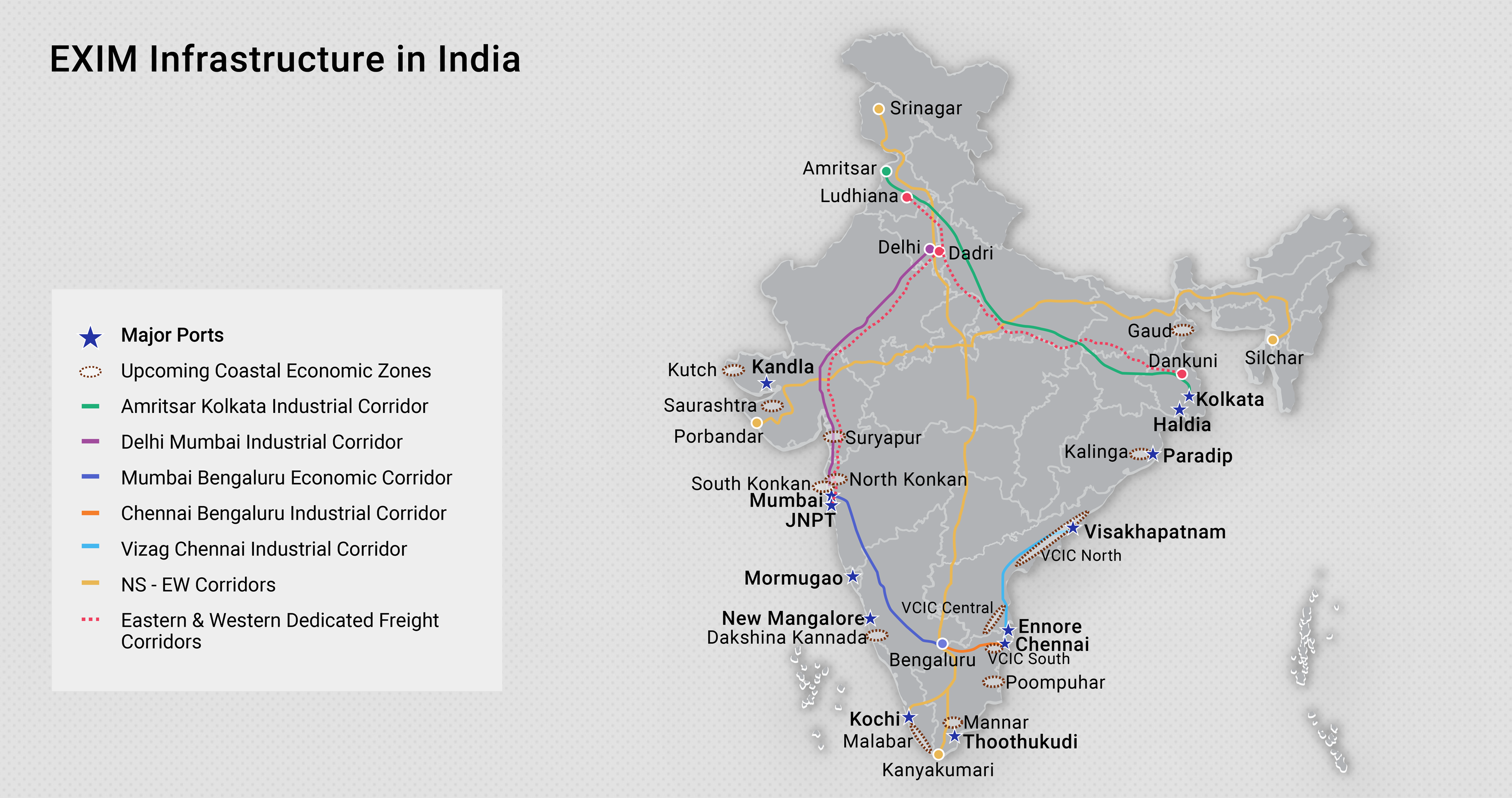
EXIM Infrastructure
About 95% of India’s merchandise trade (by volume) is handled by its maritime transport. Jawaharlal Nehru Port Trust (JNPT) in Maharashtra is India’s largest port, handling 55% of container cargo across all major ports. Currently, the country has a presence of 290 inland container depots and freight stations for trade (includes those under implementation).
To reduce the logistics cost for cargo and promote port-led industrial development, the Government of India launched the Sagarmala Programme under which 6 new major ports and 14 coastal economic zones have been identified for development. The Programme’s four main pillars are port-modernization, better port-connectivity, port-led industrialization and coastal community development.
With a targeted construction of 40 km of national highway every day during 2018-19, the world’s 2nd largest road network in India is aiming to reach the pinnacle soon. For efficient movement of goods and better district-level connectivity, the project of Bharatmala Pariyojana was launched by the Government of India in 2015. The Project aims to develop 50 new industrial corridors, add 34,800 km of road network in its Phase-I, including 10,000 km of the residual road network under NHDP and connect 550 districts through four-lane national highways.
Trade through railways in India is also prominent, with the Indian Railways transporting over 1.4 Bn Tonnes of freight in 2023-24. There are 6 high-capacity, high-speed freight corridors coming up in the country to support the Indian Railways to manage 40% modal freight share of the economy.